US National Debt: $36 Trillion & Federal Spending Impact
Advertisements
The rising $36 trillion US national debt significantly impacts federal spending by diverting substantial portions of the budget to interest payments, potentially reducing funds for essential public services and future investments, posing profound economic challenges.
The colossal figure of The Rising $36 Trillion National Debt: How Sovereign Interest Obligations Affect Federal Spending is more than just a number; it represents a profound challenge to the economic stability and future prosperity of the United States. This escalating debt demands our attention, as its implications stretch far beyond mere fiscal accounting, directly influencing the daily lives of every American citizen.
Understanding the $36 Trillion Threshold
The United States national debt has reached an unprecedented $36 trillion, a figure that continues to grow at an alarming rate. This debt comprises money owed by the federal government to various creditors, including individuals, corporations, and foreign governments, who have purchased U.S. Treasury securities. The sheer scale of this debt necessitates a deep dive into its components and the historical context that led to such an accumulation.
Historically, significant debt increases often correlate with major national events. Wars, economic crises, and expansions of social programs are common drivers. For instance, the financial crisis of 2008 and the COVID-19 pandemic saw substantial increases in government borrowing to stabilize the economy and support citizens. Understanding these drivers is crucial to appreciating the complexity of the current fiscal landscape.
Historical Context of Debt Accumulation
Examining past periods of high debt reveals patterns and policy responses. Post-World War II, the U.S. debt-to-GDP ratio was high but rapidly declined due to robust economic growth. In contrast, recent decades have seen a less optimistic trend, with debt growing faster than the economy, leading to a persistent and increasing burden. This sustained growth is a key differentiator from historical periods.
- Major wars and conflicts: Significant borrowing to fund military operations.
- Economic downturns: Increased government spending on unemployment benefits and stimulus packages.
- Tax cuts: Reductions in government revenue without corresponding spending cuts.
- Aging population: Rising costs for Social Security and Medicare.
The transition from a balanced budget philosophy to one more accepting of deficits has also played a role. Political cycles often prioritize short-term gains over long-term fiscal health, contributing to continuous borrowing. This approach, while sometimes necessary in emergencies, becomes problematic when it becomes the norm.
The Mechanics of Sovereign Interest Obligations

Sovereign interest obligations represent the payments the U.S. government must make to holders of its debt. These payments are not optional; they are a contractual commitment. The scale of the national debt means these interest payments consume an increasingly larger portion of the federal budget, diverting funds that could otherwise be used for other critical areas.
When the government issues Treasury bonds, bills, and notes, it promises to pay back the principal amount plus interest over a specified period. The interest rate on this debt is influenced by several factors, including market demand for U.S. debt, inflation expectations, and the Federal Reserve's monetary policy. Higher interest rates directly translate to higher interest payments, exacerbating the fiscal challenge.
Factors Influencing Interest Rates
Several economic variables dictate the cost of borrowing for the U.S. government. A strong economy typically allows for lower interest rates, as investors are confident in the government's ability to repay. Conversely, periods of economic uncertainty or high inflation can push rates higher, making debt servicing more expensive.
- Federal Reserve policies: Decisions on the federal funds rate directly impact short-term borrowing costs.
- Inflation expectations: Lenders demand higher interest to compensate for the erosion of purchasing power.
- Global economic stability: Safe-haven demand for U.S. Treasuries can lower rates during international crises.
- Credit ratings: A downgrade in the U.S. credit rating could increase borrowing costs.
The sheer volume of outstanding debt also plays a role. As the debt grows, the market's perception of risk can shift, potentially requiring higher yields to attract investors. This creates a feedback loop where increased debt can lead to higher interest rates, which in turn makes the debt even more expensive to manage. Understanding these dynamics is essential for grasping the full scope of the problem.
Impact on Federal Spending Priorities
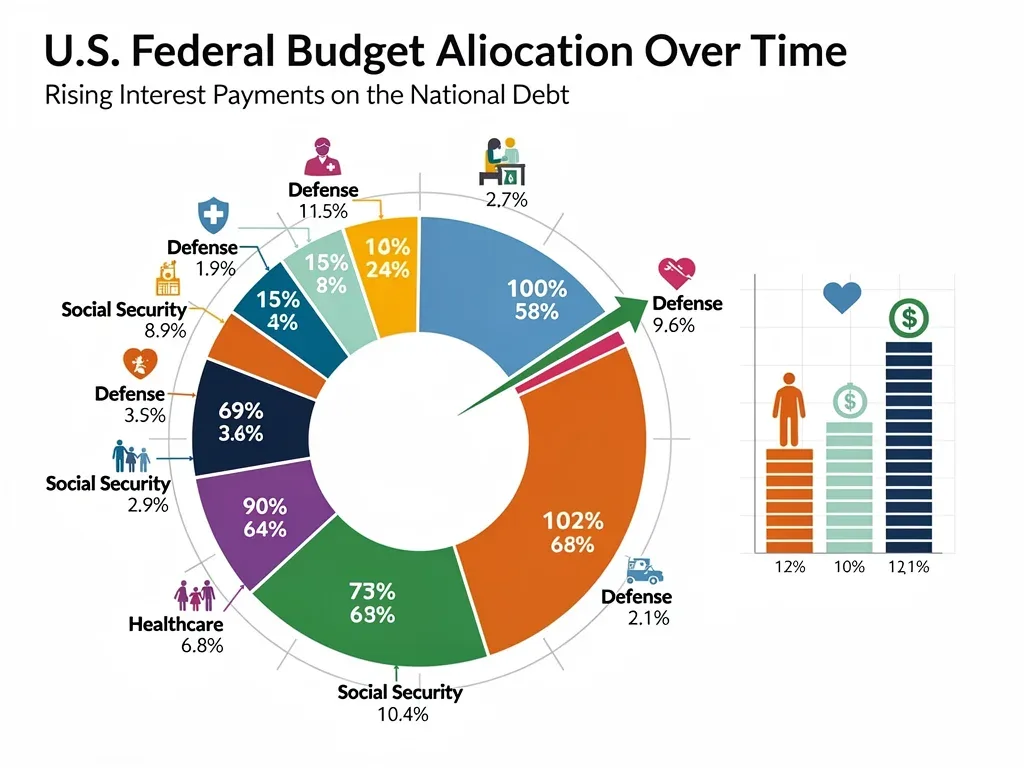
The burgeoning cost of servicing the national debt has a direct and significant impact on federal spending priorities. Each dollar spent on interest payments is a dollar that cannot be allocated to education, infrastructure, scientific research, defense, or social safety nets. This creates a zero-sum game within the federal budget, forcing difficult choices and potentially hindering future growth.
As interest obligations rise, they can crowd out other essential investments. For example, if interest payments absorb an increasing percentage of tax revenues, there is less available for discretionary spending. This can lead to underfunding of critical public services, which can have long-term negative consequences for the nation's competitiveness and quality of life.
Crowding Out Public Investment
The concept of "crowding out" is particularly relevant here. When the government borrows heavily, it competes with private sector borrowers for available capital. This can drive up interest rates across the board, making it more expensive for businesses to invest and expand, thereby stifling economic growth. The opportunity cost of debt servicing is immense.
- Reduced funding for infrastructure projects: Bridges, roads, and public transportation suffer from lack of investment.
- Lower investments in education and R&D: Impeding future innovation and human capital development.
- Constraints on defense spending: Affecting national security capabilities.
- Pressure on social programs: Potentially leading to benefit cuts or eligibility changes.
The long-term effects of this crowding out are particularly concerning. A nation that underinvests in its future—be it through infrastructure, education, or research—risks losing its competitive edge and experiencing slower economic growth. The current trajectory suggests that interest payments could soon become one of the largest line items in the federal budget, surpassing even defense spending.
Economic Consequences of High Debt
A high national debt, particularly when coupled with significant interest obligations, carries a range of adverse economic consequences. These can manifest in various ways, from inflationary pressures to reduced fiscal flexibility, ultimately affecting economic stability and growth.
One primary concern is the potential for inflation. If the Federal Reserve monetizes the debt—essentially printing more money to buy government bonds—it increases the money supply, which can lead to higher prices. Even without direct monetization, sustained large deficits can signal to markets that inflation is a risk, prompting investors to demand higher yields on government bonds.
Inflationary Pressures and Fiscal Instability
Persistent deficits and a rising debt burden can also erode confidence in the government's financial health. This can lead to a loss of investor confidence, potentially driving down the value of the dollar and making imports more expensive. Such instability can deter foreign investment and create uncertainty in financial markets.
- Higher interest rates for consumers and businesses: Increased borrowing costs for mortgages, car loans, and business expansion.
- Currency depreciation: Making imports more expensive and reducing purchasing power.
- Risk of fiscal crisis: A sudden loss of investor confidence could trigger a rapid increase in borrowing costs.
- Intergenerational equity concerns: Future generations bearing the burden of current spending.
Furthermore, high debt limits the government's ability to respond to future crises. In an economic downturn or during a national emergency, a government already burdened by massive debt has less room to implement fiscal stimulus or undertake necessary spending. This lack of fiscal space can prolong recessions and exacerbate their impact, making the economy more vulnerable to shocks.
Policy Challenges and Potential Solutions
Addressing the rising national debt and its associated interest obligations presents formidable policy challenges. There is no single, easy solution, and any effective strategy will likely require a combination of fiscal adjustments, economic growth initiatives, and political will. The sheer scale of the problem demands a comprehensive and bipartisan approach.
One fundamental approach involves reducing future deficits. This can be achieved through spending cuts, revenue increases, or a combination of both. However, identifying specific areas for cuts or tax increases often faces significant political resistance, making consensus difficult to achieve. Tough decisions on entitlements, defense, and other major spending categories are often necessary.

Strategies for Debt Reduction
Beyond direct fiscal adjustments, promoting robust economic growth is another critical component of debt management. A growing economy generates more tax revenue and can make existing debt more manageable relative to GDP. Policies that encourage investment, innovation, and productivity can contribute significantly to this goal.
- Spending reforms: Reforming entitlement programs like Social Security and Medicare to ensure long-term solvency.
- Tax policy adjustments: Broadening the tax base or adjusting rates to increase revenue.
- Investment in human capital: Education and workforce training to boost productivity.
- Infrastructure development: Improving efficiency and fostering economic activity.
The political landscape often complicates these efforts. Short-term electoral cycles can incentivize policies that defer difficult choices, pushing the problem onto future administrations. Building a political consensus around long-term fiscal responsibility is perhaps the greatest challenge, requiring leadership and a willingness to compromise for the nation's enduring economic health.
The Future Outlook for US Fiscal Health
The future outlook for U.S. fiscal health largely depends on the policy choices made today and in the coming years. Without significant changes, projections indicate that the national debt and interest obligations will continue to grow, potentially leading to more severe economic consequences. Understanding these projections is the first step toward informed decision-making.
Current trends suggest that interest payments could become the fastest-growing component of the federal budget. This trajectory is unsustainable in the long run, as it would inevitably lead to a situation where an ever-larger share of federal revenue is consumed by debt servicing, leaving fewer resources for everything else. This future scenario underscores the urgency of addressing the issue proactively.
Long-Term Projections and Risks
Various organizations, including the Congressional Budget Office (CBO), regularly publish long-term budget projections. These reports consistently highlight the unsustainable path of current fiscal policy, driven by an aging population, rising healthcare costs, and insufficient revenue to cover spending commitments. These projections are not predictions but rather warnings of what could happen if current policies remain unchanged.
- Increased risk of financial crises: Higher debt makes the economy more fragile.
- Reduced geopolitical influence: A weakened fiscal position can undermine international standing.
- Lower living standards: Due to reduced public services and higher taxes on future generations.
- Potential for sovereign debt default: Although unlikely for the U.S., it remains a theoretical risk if debt becomes unmanageable.
The decisions made today will profoundly shape the economic environment for future generations. A failure to address the national debt could leave them with a diminished economy, fewer opportunities, and a heavier tax burden. Conversely, a commitment to fiscal responsibility could pave the way for sustained economic growth and a more secure financial future for the United States.
Global Implications of US Debt
The sheer size of the U.S. national debt and its interest obligations has significant global implications, given the dollar's role as the world's primary reserve currency and the U.S. economy's interconnectedness with global markets. What happens in the U.S. fiscal landscape doesn't stay in the U.S.; it reverberates worldwide.
Many countries and international institutions hold U.S. Treasury securities as part of their foreign exchange reserves, valuing their liquidity and perceived safety. A loss of confidence in the U.S. government's ability to manage its debt could destabilize global financial markets, triggering capital flight and currency fluctuations in other nations. This interconnectedness means that the U.S. fiscal health is a global concern.
International Confidence and Stability
The stability of the U.S. economy and its fiscal policy directly influences global trade, investment, and financial flows. A weakening U.S. fiscal position could lead to a depreciation of the dollar, impacting countries that rely on a stable dollar for trade or those holding substantial dollar-denominated assets. This can create ripple effects, affecting inflation and economic growth in other nations.
- Impact on global interest rates: U.S. borrowing costs can influence rates internationally.
- Dollar's reserve currency status: Erosion of confidence could challenge its dominant role.
- Trade imbalances: Affecting countries that are major exporters to the U.S.
- Geopolitical leverage: A strong economy underpins diplomatic and military influence.
Moreover, if the U.S. were to face a severe fiscal crisis, the global economy would likely experience significant disruption. The interconnected nature of financial systems means that a crisis in one major economy can quickly spread, creating a cascade of negative effects. Therefore, global stakeholders have a vested interest in the U.S. addressing its national debt challenges effectively and sustainably.
| Key Aspect | Brief Description |
|---|---|
| Debt Magnitude | The US national debt has surpassed $36 trillion, demanding significant fiscal attention and management. |
| Interest Obligations | Interest payments on this debt consume a growing portion of the federal budget, reducing funds for other priorities. |
| Economic Impact | High debt can lead to inflation, higher interest rates for consumers, and reduced government flexibility during crises. |
| Policy Challenges | Requires bipartisan effort, spending reforms, and economic growth strategies to ensure long-term fiscal health. |
Frequently Asked Questions About the National Debt
What is the US national debt and why is it so high?▼The US national debt is the total amount of money the federal government owes. It's high due to consistent budget deficits, driven by factors like increased spending on social programs, defense, tax cuts, and responses to economic crises such as the 2008 recession and the COVID-19 pandemic.
How do sovereign interest obligations affect federal spending?▼Sovereign interest obligations are mandatory payments on the national debt. As the debt grows, these payments consume a larger portion of the federal budget, diverting funds from other critical areas like education, infrastructure, and healthcare, thereby limiting fiscal flexibility.
What are the economic consequences of a rising national debt?▼A rising national debt can lead to several economic consequences, including inflationary pressures, higher interest rates for consumers and businesses, reduced public investment, potential currency depreciation, and a diminished capacity for the government to respond to future economic downturns effectively.
Can the US national debt be reduced, and how?▼Reducing the national debt requires a combination of strategies. These include fiscal adjustments such as spending cuts (e.g., entitlement reform), revenue increases (e.g., tax policy changes), and policies that foster robust economic growth. Political consensus and long-term planning are crucial for success.
What are the global implications of the US national debt?▼Given the dollar's status as the global reserve currency, the US national debt has significant international implications. A loss of confidence in US fiscal health could destabilize global financial markets, impact international trade, affect global interest rates, and potentially challenge the dollar's dominant role.
Conclusion
The journey to understand The Rising $36 Trillion National Debt: How Sovereign Interest Obligations Affect Federal Spending reveals a complex and pressing challenge for the United States. This monumental debt is not merely an abstract financial figure; it is a tangible force reshaping federal priorities, influencing economic stability, and casting a long shadow over future generations. Addressing this fiscal reality demands a clear-eyed assessment of current spending patterns, a commitment to sustainable economic growth, and the political courage to implement difficult but necessary reforms. The path forward requires a unified effort to ensure long-term fiscal health, safeguarding the nation's economic vitality and its standing in the global arena for years to come. Only through proactive and comprehensive strategies can the U.S. navigate this fiscal tightrope and build a more secure financial future.
