EV Tax Credit: New IRS Rules Clarify $7,500 Eligibility
Advertisements
The IRS has clarified the new national EV rebate rules, detailing eligibility for the $7,500 tax credit, including critical mineral and battery component sourcing, vehicle manufacturing, and income caps for buyers.
The landscape of electric vehicle (EV) incentives is undergoing a significant transformation. With new EV tax credit rules now in effect, the IRS has provided much-needed clarity on the eligibility standards for the popular $7,500 federal tax credit, impacting both manufacturers and prospective buyers across the United States.
Understanding the Revised Federal EV Tax Credit Landscape
The federal EV tax credit, a cornerstone of the nation's push towards sustainable transportation, has seen substantial revisions. These changes, primarily driven by the Inflation Reduction Act (IRA), aim to bolster domestic manufacturing and reduce reliance on foreign supply chains for critical EV components.
For consumers, navigating these updated regulations is crucial to ensure they qualify for the substantial $7,500 incentive. The IRS clarifications are designed to provide a framework that supports both environmental goals and economic development within the U.S.
Key Legislative Drivers and Their Impact
The Inflation Reduction Act introduced stringent requirements that directly influence EV tax credit eligibility. These include:
- Stricter criteria for vehicle assembly locations.
- New thresholds for critical mineral sourcing.
- Specific percentages for battery component manufacturing.
These provisions are not merely bureaucratic hurdles; they represent a strategic shift towards strengthening the American EV industry from raw materials to final assembly. Understanding these legislative drivers helps consumers grasp why certain vehicles qualify and others do not.
The revised federal EV tax credit landscape is dynamic, and both car buyers and manufacturers must stay informed. The IRS has committed to regular updates as the market evolves and new models become available, ensuring transparency in the application of these rules. Ultimately, these changes seek to create a more resilient and domestically focused EV supply chain while making clean vehicles more accessible to American families.
Navigating the $7,500 Tax Credit: What Buyers Need to Know
Securing the full $7,500 federal EV tax credit requires careful attention to several key criteria. Prospective buyers must be aware of both vehicle-specific requirements and personal income limitations to ensure they qualify for this significant financial incentive.
The complexity of these rules means that not all electric vehicles will be eligible, and not all buyers will meet the income thresholds. Diligent research before purchase is paramount.
Vehicle Eligibility: Assembly and Price Caps
One of the most significant changes concerns where the vehicle is assembled. To qualify, an EV must undergo final assembly in North America. This requirement aims to stimulate manufacturing jobs within the region.
Furthermore, there are strict Manufacturer's Suggested Retail Price (MSRP) caps:
- Vans, SUVs, and pickup trucks: Maximum MSRP of $80,000.
- Other vehicles (sedans, coupes, etc.): Maximum MSRP of $55,000.
These price caps are designed to ensure the tax credit benefits a broader range of consumers and not just those purchasing luxury EVs. Buyers should always verify the MSRP of their chosen vehicle against these limits.
Beyond assembly and price, buyers must also consider the vehicle's battery components and critical mineral sourcing, which are detailed further in subsequent sections. The IRS provides a regularly updated list of eligible vehicles on its website, which is an invaluable resource for consumers.
Critical Mineral and Battery Component Sourcing Requirements
A major focus of the new EV tax credit rules is the origin of critical minerals and battery components. These requirements are designed to reduce reliance on non-allied nations and strengthen domestic supply chains, making the credit more than just an environmental incentive.
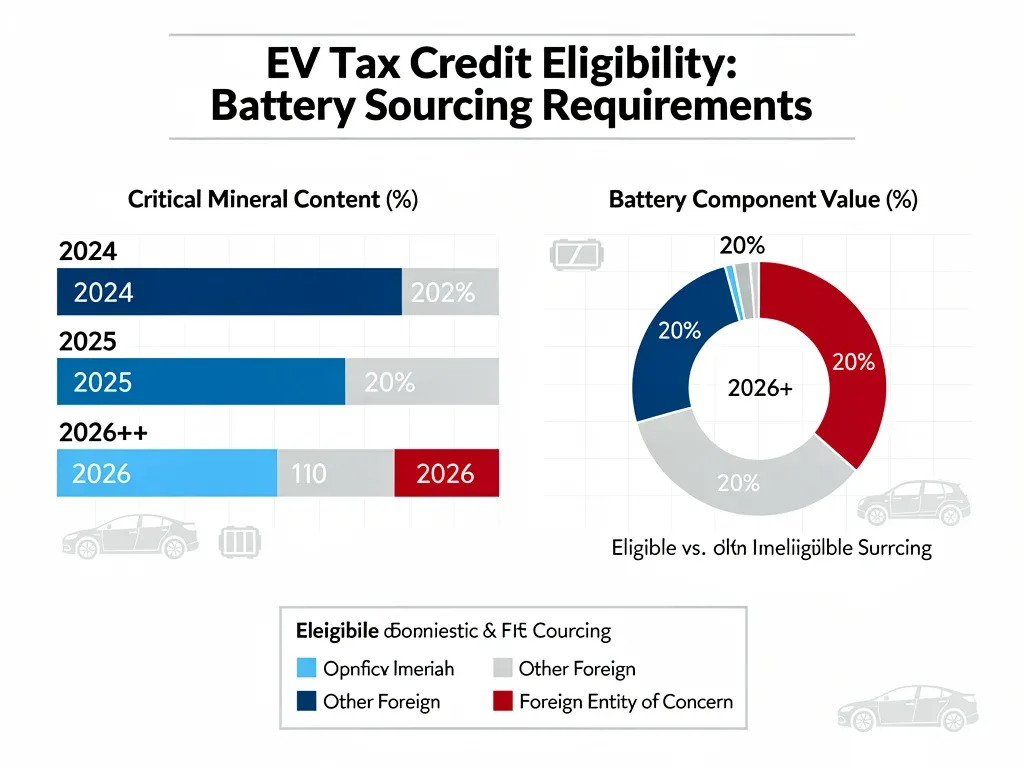
The IRS has outlined specific percentages that must be met for both critical minerals and battery components, with these percentages set to increase over time.
Domestic Content Mandates Explained
For a vehicle to qualify for the full $7,500 credit, it must satisfy two distinct requirements, each contributing $3,750:
- Critical Mineral Requirement: A certain percentage of the value of the critical minerals contained in the EV's battery must be extracted or processed in the United States, or in a country with which the U.S. has a free trade agreement, or be recycled in North America.
- Battery Component Requirement: A specified percentage of the value of the battery components must be manufactured or assembled in North America.
These percentages escalate annually. For example, in 2023, the critical mineral requirement was 40% and the battery component requirement was 50%. These percentages will continue to rise, making it progressively more challenging for vehicles to qualify unless their supply chains adapt.
Manufacturers are working diligently to reconfigure their supply chains to meet these stringent requirements. This shift is not only about tax credits but also about building a more secure and sustainable EV industry within North America. Consumers should consult the latest IRS guidance to see which vehicles meet these evolving criteria.
Income Limitations and Buyer Eligibility Criteria
Beyond the vehicle itself, the new EV tax credit rules also impose significant income limitations on buyers. These caps are intended to ensure that the federal incentive primarily benefits middle and lower-income households, making EVs more accessible to a broader demographic.
Understanding these income thresholds is crucial, as exceeding them will automatically disqualify a buyer from receiving the credit, regardless of the vehicle's eligibility.
Adjusted Gross Income (AGI) Caps for Individuals and Households
The IRS has established specific Adjusted Gross Income (AGI) limits for qualifying for the clean vehicle tax credit:
- Married filing jointly: AGI cannot exceed $300,000.
- Head of household: AGI cannot exceed $225,000.
- All other filers (single, married filing separately): AGI cannot exceed $150,000.
These income thresholds apply to the tax year in which the vehicle is purchased or the preceding tax year, whichever is less. Buyers should calculate their AGI carefully to determine their eligibility. This provision ensures that the tax credit is targeted towards those who might need it most to make the transition to an EV.
It's important to note that these AGI limits are strict. If a buyer's income is even slightly above the cap, they will not be eligible for the credit. Financial planning and consulting with a tax professional can help potential buyers understand their specific situation and how these income limitations apply to them.

Impact on the EV Market: Manufacturers and Consumers
The implementation of these new EV tax credit rules has sent ripples throughout the electric vehicle market, affecting both manufacturers' strategies and consumers' purchasing decisions. The goal is to stimulate domestic production, but the immediate effect can be a reduction in eligible models.
Manufacturers are rapidly adjusting their supply chains and production processes to meet the stringent requirements, while consumers face a more complex landscape when choosing an EV.
Manufacturer Adjustments and Supply Chain Realignments
Automakers are investing heavily in North American manufacturing facilities and establishing new partnerships for critical mineral extraction and processing. This includes:
- Building battery plants in the U.S.
- Securing long-term contracts with domestic or free-trade-agreement-partner suppliers.
- Re-evaluating vehicle models for final assembly locations.
These strategic shifts are massive undertakings, requiring billions in investment and years to fully implement. The immediate consequence is that some previously eligible models may lose their tax credit status until manufacturers can comply with the new rules.
For consumers, this means fewer options might initially qualify for the full $7,500 credit. However, as manufacturers adapt, the list of eligible vehicles is expected to grow, offering more domestically produced options. This transition period requires patience and careful monitoring of IRS updates.
Future Outlook: What to Expect from EV Incentives
The landscape of EV incentives is not static; it is a continuously evolving area driven by policy objectives, technological advancements, and market dynamics. The current IRS clarifications are just one step in a longer journey towards a fully electrified transportation system in the United States.
Future changes are likely, and staying informed will be key for both industry stakeholders and individual consumers.

Potential Policy Revisions and Market Evolution
As the EV market matures and domestic supply chains strengthen, it is reasonable to expect further adjustments to the tax credit rules. These could include:
- Modifications to critical mineral and battery component percentage requirements.
- Revisions to MSRP caps or income limitations based on economic conditions.
- Introduction of new incentives for charging infrastructure or used EVs.
Policymakers will likely continue to balance environmental goals with economic development, ensuring that incentives remain effective without creating undue market distortions. The push for a robust domestic EV industry is a long-term commitment, and incentives will adapt to support this vision.
Consumers should keep an eye on official IRS publications and reputable automotive news sources for the latest updates. The goal of these incentives is to accelerate EV adoption, and as the industry grows, the mechanisms for achieving that goal will also evolve, potentially offering new opportunities for savings in the future.
| Key Aspect | Brief Description |
|---|---|
| Vehicle Assembly | Must be finally assembled in North America to qualify for the credit. |
| Critical Minerals | Percentage of minerals sourced or processed in U.S. or free-trade partners. |
| Battery Components | Percentage of battery components manufactured or assembled in North America. |
| Income Limits | AGI caps apply to buyers: $300k (joint), $225k (HOH), $150k (others). |
Frequently Asked Questions About EV Tax Credits
What is the primary purpose of the new EV tax credit rules?▼The new rules aim to bolster domestic manufacturing and reduce reliance on foreign supply chains for critical EV components, while also making electric vehicles more accessible to a broader range of American consumers through targeted incentives.
How do I know if a specific EV qualifies for the $7,500 credit?▼The IRS provides an official, regularly updated list of eligible vehicles on its website. This list details which models meet the final assembly, critical mineral, and battery component requirements. Always check this resource before purchasing.
Are there income limits to claim the federal EV tax credit?▼Yes, strict Adjusted Gross Income (AGI) caps apply. For married filing jointly, the limit is $300,000; for head of household, $225,000; and for all other filers, $150,000. These limits apply to the purchase year or the preceding year.
What are the critical mineral and battery component requirements?▼A certain percentage of critical minerals must be sourced from the U.S. or free-trade partners, and a percentage of battery components must be manufactured or assembled in North America. These percentages increase annually.
Can I get the tax credit for a used electric vehicle?▼The Inflation Reduction Act also introduced a separate tax credit for used clean vehicles, offering up to $4,000. This credit has its own set of eligibility criteria, including vehicle age, price caps, and buyer income limits.
Conclusion
The new national EV rebate rules, clarified by the IRS, represent a significant evolution in federal incentives for electric vehicles. These regulations are meticulously designed to foster a robust domestic EV supply chain, from critical minerals to final assembly, while also ensuring that the substantial $7,500 tax credit benefits a broad spectrum of American consumers. Understanding the intricacies of vehicle eligibility, sourcing requirements, and personal income limitations is paramount for anyone considering an EV purchase. While the initial adjustments may present challenges for both manufacturers and buyers, these measures are ultimately aimed at accelerating the transition to a sustainable transportation future and strengthening the U.S. economy in the process. Staying informed through official IRS updates will empower consumers to make the most of these evolving opportunities.
