Secure Your Smart Home: Auditing Matter 1.4 for IoT Security
Advertisements
Auditing Matter 1.4 protocol devices is crucial for securing your smart home against the 12 most common IoT attack vectors, ensuring robust protection for your connected environment.
As our homes become increasingly connected, the question, Is Your Smart Home Secure? Auditing Matter 1.4 Protocol Devices to Block 12 Common IoT Attack Vectors, has never been more pertinent. The convenience offered by smart devices often comes with inherent security risks that, if not addressed, can compromise your privacy and safety. Understanding and mitigating these vulnerabilities is essential for any modern homeowner.
Understanding the Matter 1.4 Protocol and Its Security Implications
The Matter 1.4 protocol represents a significant step forward in smart home interoperability, aiming to simplify device communication and enhance user experience. However, with greater connectivity comes an expanded attack surface that requires careful consideration of security implications. This section delves into what Matter 1.4 entails and why its security is paramount.
Matter, developed by the Connectivity Standards Alliance (CSA), is designed to be an open-source connectivity standard that allows smart home devices from different manufacturers to work together seamlessly. Version 1.4 brings further refinements, performance improvements, and expanded device support. While this unification is beneficial for consumers, it also means that a vulnerability in one device or implementation could potentially impact the entire smart home ecosystem.
Core Security Principles of Matter 1.4
Matter 1.4 incorporates several security features by design, including device attestation, secure over-the-air (OTA) updates, and robust encryption. These are fundamental to establishing a baseline of trust and protection. Device attestation, for example, helps ensure that only legitimate, certified devices can join your Matter network, preventing unauthorized or counterfeit hardware from gaining access.
- Device Attestation: Verifies the authenticity and integrity of devices joining the network.
- Secure OTA Updates: Ensures firmware updates are legitimate and haven't been tampered with.
- Strong Encryption: Protects all communication between Matter devices and controllers.
- Access Control Lists (ACLs): Manages which users and devices have permission to control specific functions.
Despite these built-in safeguards, the implementation and ongoing management of these features are critical. A protocol is only as secure as its weakest link, which often lies in the hands of device manufacturers and end-users. Therefore, a proactive auditing approach is indispensable to identify and address potential weaknesses before they can be exploited.
Identifying the 12 Common IoT Attack Vectors in Smart Homes
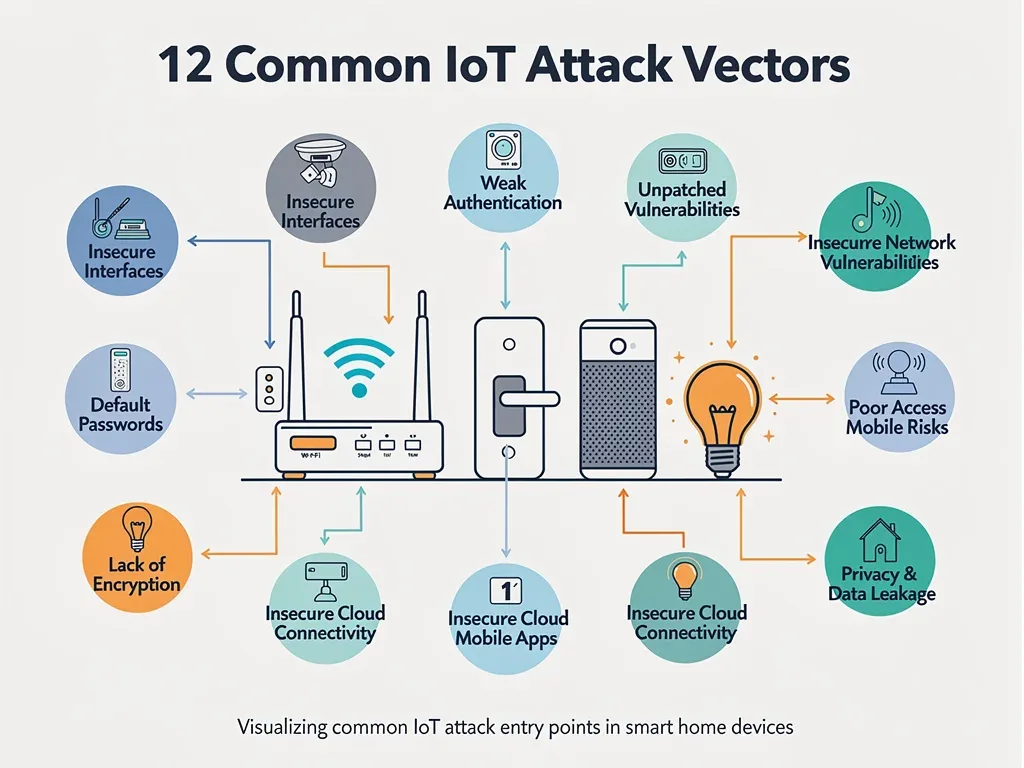
Smart homes, by their very nature, are attractive targets for cybercriminals due to the wealth of personal data they collect and the potential for disruption. Understanding the common ways these systems can be compromised is the first step in building a resilient defense. Here, we outline 12 prevalent IoT attack vectors that every smart home owner should be aware of.
These attack vectors range from basic configuration flaws to sophisticated exploits targeting underlying software vulnerabilities. Cybercriminals continuously evolve their tactics, making it crucial to stay informed and vigilant. Recognizing these patterns allows for targeted auditing and mitigation strategies.
Top IoT Vulnerabilities to Watch For
Many attacks exploit well-known weaknesses that could be prevented with proper security practices. Neglecting these can leave your smart home wide open to malicious actors. For instance, default passwords are a notorious entry point for attackers.
- Weak, Guessable, or Hardcoded Passwords: Easy access for unauthorized users.
- Insecure Network Services: Open ports or services that can be exploited.
- Lack of Secure Update Mechanism: Inability to patch vulnerabilities effectively.
- Insecure Data Transfer and Storage: Unencrypted data or improper storage leading to breaches.
- Lack of Device Management: Inadequate tools for monitoring and controlling devices.
- Insecure Default Settings: Devices configured with poor security out-of-the-box.
- Physical Tampering: Unauthorized access to devices for direct manipulation.
- Lack of Privacy by Design: Devices collecting excessive or unnecessary personal data.
- Insecure Web Interface: Vulnerabilities in device web management portals.
- Insufficient Authorization/Authentication: Poor access control mechanisms.
- Software/Firmware Vulnerabilities: Bugs or flaws in device operating systems.
- Side-Channel Attacks: Exploiting information leaked through physical implementations.
Each of these vectors represents a potential doorway for attackers. A comprehensive audit of your Matter 1.4 devices must consider how each of these vulnerabilities might manifest within your specific smart home setup. Proactive identification and remediation are key to maintaining a secure environment.
Auditing Your Matter 1.4 Devices: A Step-by-Step Guide
Auditing your Matter 1.4 devices is not just about checking boxes; it's about systematically evaluating their security posture against known threats. This process empowers you to identify and mitigate vulnerabilities, transforming your smart home from a potential target into a fortified sanctuary. A structured approach ensures no critical area is overlooked.
The audit should be an ongoing process, not a one-time event, as new threats emerge and device configurations change. Regular checks help maintain a high level of security. Begin by inventorying all your Matter 1.4 compatible devices, understanding their functions, and identifying their network connections.
Practical Steps for a Comprehensive Security Audit
Start with the basics, like reviewing device documentation, and then move on to more technical assessments. This phased approach helps manage the complexity of securing a diverse smart home ecosystem.
- Inventory All Devices: List every Matter 1.4 device, its manufacturer, model, and firmware version.
- Review Default Settings: Change all default passwords and disable unnecessary services.
- Check for Firmware Updates: Ensure all devices are running the latest, most secure firmware.
- Assess Network Segmentation: Consider isolating smart devices on a separate VLAN to limit lateral movement in case of a breach.
- Analyze Data Flow: Understand what data each device collects, where it's stored, and how it's transmitted.
- Evaluate Access Controls: Verify user permissions and ensure strong, unique passwords for all accounts.
- Monitor Network Traffic: Look for unusual activity or unauthorized communication attempts.

By following these steps, you can systematically uncover potential weak points in your Matter 1.4 ecosystem. Documenting your findings and implementing corrective actions are vital components of a successful audit. This diligent approach forms the bedrock of a truly secure smart home.
Best Practices for Blocking Common IoT Attack Vectors
Once you've identified potential vulnerabilities through auditing, the next critical step is to implement effective measures to block these common IoT attack vectors. This involves a combination of technical configurations, user education, and continuous vigilance. Proactive defense is always better than reactive recovery.
Securing your smart home is an ongoing commitment, not a one-time fix. The strategies outlined here are designed to provide robust, layered protection against the most prevalent threats. Each practice contributes to a stronger overall security posture.
Implementing Robust Security Measures
Focus on foundational security principles that apply broadly across your Matter 1.4 devices. Strong authentication, regular updates, and network segregation are non-negotiable for a secure environment.
- Strong, Unique Passwords: Use complex, unique passwords for every device and service.
- Multi-Factor Authentication (MFA): Enable MFA wherever possible for an extra layer of security.
- Regular Firmware Updates: Always install updates promptly to patch known vulnerabilities.
- Network Segmentation: Isolate IoT devices on a guest network or separate VLAN.
- Disable Unused Features: Turn off any features or services not actively in use on your devices.
- Firewall Configuration: Use a robust firewall to control inbound and outbound traffic.
- Data Encryption: Ensure all sensitive data is encrypted, both in transit and at rest.
- Physical Security: Secure physical access to devices to prevent tampering.
By consistently applying these best practices, you significantly reduce the likelihood of your smart home falling victim to cyberattacks. These measures are not exhaustive but form a strong defense against the vast majority of common IoT attack vectors. Continuous monitoring and adaptation are also essential components of an effective security strategy.
Leveraging Matter 1.4 Features for Enhanced Security
The Matter 1.4 protocol isn't just about interoperability; it also provides a foundation for enhanced security if its features are properly utilized. Understanding how to leverage these built-in capabilities can significantly bolster your smart home's defenses against a myriad of threats. It's about maximizing the security potential that the standard offers.
Many of Matter's security aspects operate silently in the background, but knowing they are there and how to verify their operation is crucial. For instance, the secure commissioning process is a cornerstone of Matter's security, ensuring devices are added to your network safely and authentically.
Utilizing Matter's Built-in Protections
Beyond basic configurations, Matter 1.4 offers advanced security mechanisms that, when properly implemented, create a more resilient ecosystem. These include secure boot processes and robust key management.
- Secure Commissioning: Ensures new devices are added to the network securely and authentically.
- Device Attestation: Verifies the identity and integrity of devices during onboarding.
- Access Control Lists (ACLs): Granularly define which users or devices can control specific functions.
- Secure Over-the-Air (OTA) Updates: Guarantees the authenticity and integrity of firmware updates.
- End-to-End Encryption: Protects all communication between Matter devices and controllers.
- Distributed Ledger Technology (DLT) for Trust: Some Matter implementations may leverage DLT for enhanced trust and transparency in device identity.
Properly configuring and maintaining Matter 1.4 devices to fully utilize these features is paramount. It requires users to engage with their device settings and ensure that all available security options are enabled and correctly configured. This proactive engagement transforms Matter's potential into practical security for your smart home.
The Future of Smart Home Security with Matter 1.4 and Beyond
The landscape of smart home security is constantly evolving, with Matter 1.4 representing a significant milestone. However, the journey towards truly impenetrable smart homes is ongoing. Anticipating future threats and understanding the direction of security advancements is key to staying ahead of cybercriminals. The industry is continuously working to address emerging challenges.
As more devices become Matter 1.4 compatible, the need for standardized security practices will only grow. The protocol's open-source nature fosters collaboration among manufacturers, leading to faster identification and remediation of vulnerabilities. This collective effort is vital for the long-term security of the smart home ecosystem.
Evolving Security Paradigms and Challenges
Looking ahead, advancements in AI, machine learning, and quantum-resistant cryptography will play increasingly important roles in smart home security. These technologies promise to offer more sophisticated detection and prevention mechanisms.
- AI-Powered Threat Detection: Machine learning algorithms analyzing network traffic for anomalies.
- Quantum-Resistant Cryptography: Preparing for the advent of quantum computing and its potential to break current encryption.
- Decentralized Identity Management: Enhancing user privacy and control over personal data.
- Zero-Trust Architectures: Implementing a 'never trust, always verify' approach within the smart home network.
- Regulatory and Policy Development: Governments and industry bodies establishing clearer security standards and certifications.
The continued development of Matter, alongside these broader technological advancements, promises a more secure and resilient smart home experience. However, user awareness and active participation in securing their own environments will remain indispensable. The future of smart home security is a shared responsibility, driven by innovation and informed consumer choices.

| Key Security Aspect | Brief Description |
|---|---|
| Matter 1.4 Protocol | Open-source connectivity standard for smart home devices, integrating security features like attestation and encryption. |
| Common IoT Attack Vectors | 12 prevalent vulnerabilities including weak passwords, insecure updates, and software flaws, often exploited by cybercriminals. |
| Device Auditing | Systematic evaluation of device security posture, involving inventory, configuration review, and firmware checks. |
| Security Best Practices | Implementing strong passwords, MFA, network segmentation, and regular updates to prevent cyberattacks. |
Frequently Asked Questions About Smart Home Security
What is the Matter 1.4 protocol and why is it important for smart home security?▼Matter 1.4 is an open-source connectivity standard designed to unify smart home devices. It's crucial for security because it builds in features like device attestation and strong encryption, providing a baseline of trust and protection across different manufacturers' products, simplifying secure integration.
What are the most common IoT attack vectors I should be concerned about?▼The most common attack vectors include weak passwords, insecure network services, lack of secure update mechanisms, and software vulnerabilities. These can allow unauthorized access, data breaches, or device manipulation, making your smart home susceptible to various cyber threats.
How often should I audit my Matter 1.4 protocol devices for security?▼It is recommended to audit your Matter 1.4 devices at least quarterly, or whenever you add new devices, update firmware, or notice unusual network activity. Regular auditing helps identify and address new vulnerabilities as they emerge, maintaining continuous protection.
Can network segmentation really improve my smart home's security?▼Yes, network segmentation significantly enhances security by isolating IoT devices on a separate network (e.g., a guest network or VLAN). This limits the ability of an attacker to move laterally across your network if one smart device is compromised, protecting your more sensitive devices.
What role do firmware updates play in blocking IoT attack vectors?▼Firmware updates are vital for blocking IoT attack vectors as they often contain patches for newly discovered security vulnerabilities and introduce enhanced security features. Regularly applying these updates ensures your devices are protected against the latest threats and exploits.
Conclusion
Securing your smart home in an increasingly interconnected world is no longer optional but a critical necessity. By understanding the intricacies of the Matter 1.4 protocol, identifying the 12 common IoT attack vectors, and diligently implementing auditing and best practices, homeowners can significantly bolster their digital defenses. The ongoing commitment to monitoring, updating, and segmenting smart devices forms the bedrock of a resilient and private smart home environment. As technology evolves, so too must our approach to security, ensuring that convenience does not come at the cost of safety.
