RISC-V vs. ARM in 2026: Benchmarks for Embedded & Server Workloads
Advertisements
The architectural landscape for embedded systems and 64-bit server workloads in 2026 is critically shaped by the ongoing competition and evolving benchmarks between RISC-V and ARM, impacting performance, power, and market strategies across diverse applications.
The technological horizon of 2026 promises a fascinating showdown in processor architecture. The question of RISC-V vs. ARM in 2026: Architectural Benchmarks for Embedded Systems and 64-Bit Server Workloads is no longer theoretical but a tangible reality impacting design choices across industries. As we delve into this comparison, we aim to shed light on which architecture is poised to excel in various demanding applications, from tiny IoT devices to expansive data centers.
Understanding the Architectural Philosophies: RISC-V and ARM
To truly grasp the dynamics of the 2026 processor landscape, it's essential to first understand the foundational philosophies driving RISC-V and ARM. These architectures, while both based on Reduced Instruction Set Computing (RISC) principles, diverge significantly in their licensing models, flexibility, and ecosystem development, which directly influences their suitability for specific applications.
ARM, or Advanced RISC Machines, has long been the dominant force in mobile and embedded computing, characterized by its proprietary licensing model. This model has fostered a robust ecosystem of highly optimized cores and extensive software support, making it a reliable choice for performance-per-watt critical applications. Its established IP portfolio and proven track record offer a degree of certainty for developers.
ARM's Proprietary Strength
ARM's proprietary nature, while sometimes seen as a limitation, is also its strength. It allows ARM to maintain tight control over its architecture, ensuring:
- Consistent performance and power efficiency across different licensees.
- A mature and extensive software ecosystem with broad toolchain support.
- Strong intellectual property protection and established market pathways.
Conversely, RISC-V emerges as an open-standard instruction set architecture (ISA). Its open-source nature means anyone can design, manufacture, and sell RISC-V chips without paying royalties. This freedom fosters innovation and customization, making it an attractive option for niche applications and academic research, as well as for companies seeking to avoid vendor lock-in.
RISC-V's Open-Source Advantage
RISC-V's open-source model brings several compelling benefits to the forefront:
- Unprecedented flexibility and extensibility for custom instruction sets.
- Reduced licensing costs, lowering the barrier to entry for new players.
- A growing community-driven development and innovation paradigm.
The fundamental difference in their business models — proprietary versus open-source — sets the stage for their respective trajectories in the embedded and server markets by 2026. This distinction influences everything from design flexibility and cost to ecosystem maturity and long-term strategic investments.
Embedded Systems: Performance, Power, and Customization
The embedded systems market is incredibly diverse, encompassing everything from tiny microcontrollers in smart home devices to complex automotive control units. In this segment, the architectural benchmarks for 2026 will heavily emphasize a delicate balance of performance, ultra-low power consumption, and the ability for deep customization. Both RISC-V and ARM are making significant strides in these areas, but with different approaches.
ARM, with its extensive Cortex-M and Cortex-R series, has historically dominated this space. Its well-optimized cores and mature development tools provide engineers with reliable, power-efficient solutions that are easy to integrate. For many, the established ecosystem and predictable performance of ARM remain a key advantage, reducing development risks and time-to-market.
ARM's Strengths in Embedded
In 2026, ARM's embedded offerings will likely continue to leverage:
- Proven ultra-low power consumption profiles for battery-powered devices.
- Extensive software and middleware support, simplifying application development.
- A broad portfolio of IP cores optimized for various embedded tasks.
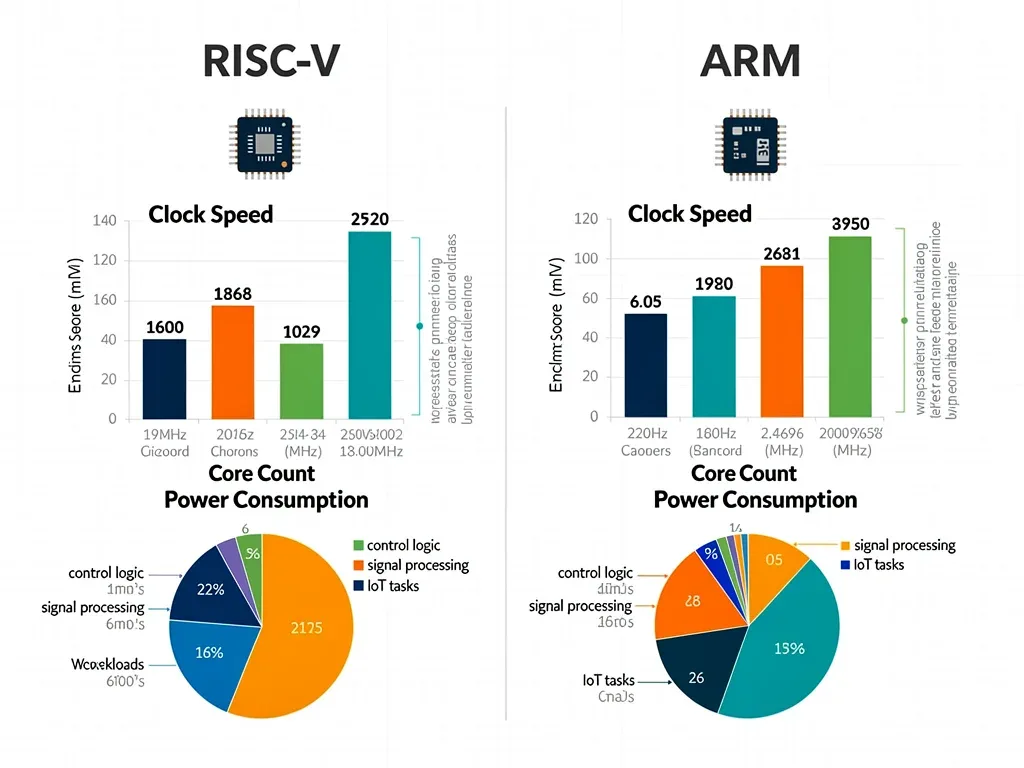
RISC-V, on the other hand, is rapidly gaining traction due to its unparalleled flexibility. Companies can design custom instructions or extensions tailored precisely to their embedded application's needs, potentially leading to highly optimized and power-efficient solutions that surpass general-purpose architectures. This level of customization is particularly appealing for specialized hardware accelerators and security-critical applications.
RISC-V's Customization Edge
The bespoke nature of RISC-V offers distinct advantages:
- Ability to create highly specialized cores for specific embedded functions.
- Potential for superior power efficiency in custom implementations.
- Freedom from licensing fees, reducing per-unit costs for high-volume products.
By 2026, we anticipate that ARM will maintain its stronghold in general-purpose embedded applications where time-to-market and ecosystem maturity are paramount. However, RISC-V is expected to carve out significant market share in highly specialized, cost-sensitive, and custom-accelerated embedded solutions, especially those requiring unique security features or domain-specific optimizations. The benchmarks will increasingly reflect the performance of these custom RISC-V implementations against ARM's standardized offerings, highlighting efficiency in specific workloads rather than raw clock speed.
64-Bit Server Workloads: Scalability, Throughput, and Ecosystem Maturity
The 64-bit server market presents a different set of challenges and opportunities. Here, architectural benchmarks revolve around scalability, raw throughput, memory bandwidth, and the robustness of the software ecosystem. While x86 has historically dominated this sector, ARM has made significant inroads, and RISC-V is emerging as a dark horse with long-term potential.
ARM's Neoverse platform, designed specifically for data centers, has demonstrated impressive performance-per-watt metrics, making it an attractive alternative for cloud providers and hyperscalers. Companies like Amazon Web Services (AWS) with their Graviton processors have proven the viability and efficiency of ARM in server environments, driving down operational costs and increasing performance density.
ARM's Server Momentum
Key factors contributing to ARM's growing presence in servers by 2026 include:
- Optimized designs for cloud-native workloads and microservices.
- Excellent power efficiency, crucial for large-scale data centers.
- Expanding software support, including major Linux distributions and virtualization platforms.
RISC-V's entry into the 64-bit server market is still nascent compared to ARM, but its open nature holds immense promise. For large data center operators, the ability to customize processor designs, potentially integrating domain-specific accelerators directly into the CPU, could offer significant advantages in performance and efficiency for specialized workloads like AI/ML inference, data analytics, or networking.
RISC-V's Server Potential
RISC-V's long-term appeal for servers lies in:
- Freedom to innovate and differentiate hardware at the silicon level.
- Potential for highly specialized processors tailored to specific data center tasks.
- Reduced long-term costs by eliminating recurring licensing fees.
By 2026, ARM is expected to solidify its position as a strong contender against x86 in general-purpose cloud and edge server deployments, driven by continued ecosystem maturation and performance improvements. RISC-V, while unlikely to achieve widespread general-purpose server dominance by 2026, will likely see significant adoption in specialized server accelerators and custom data center solutions, where its flexibility can be fully exploited. Benchmarks will increasingly focus on total cost of ownership (TCO) and workload-specific performance rather than just raw processing power.
Power Efficiency and Thermal Design Power (TDP)
In both embedded systems and server workloads, power efficiency and Thermal Design Power (TDP) are paramount. For embedded devices, lower power consumption directly translates to longer battery life and smaller form factors. In data centers, reduced power draw and heat dissipation lead to massive operational cost savings and higher rack density. Both RISC-V and ARM architectures are inherently designed for efficiency, but their approaches and resulting benchmarks will vary.
ARM has decades of experience optimizing its cores for power efficiency, a legacy from its dominance in mobile devices. Its fine-grained power management techniques and highly optimized microarchitectures consistently deliver excellent performance-per-watt. This expertise is directly transferable to embedded and server applications, where every milliwatt and every degree Celsius counts.
ARM's Power Management Prowess
ARM's advantages in power efficiency stem from:
- Sophisticated clock gating and power gating mechanisms.
- Highly optimized microarchitectures for specific workloads.
- Extensive library of low-power design IP.
RISC-V, being an open ISA, allows designers complete freedom to optimize for power. This means that a well-designed RISC-V core can achieve exceptional power efficiency, particularly when customized for a specific task. However, the onus is on the implementer to achieve this optimization, which can be a double-edged sword. While it allows for ultimate efficiency, it also requires significant design expertise.

RISC-V's Custom Power Optimization
- Ability to remove unnecessary instructions and components for a given application.
- Integration of custom hardware accelerators directly into the core for energy savings.
- Flexibility to choose specific process technologies and design methodologies.
By 2026, ARM will likely continue to lead in off-the-shelf, general-purpose power efficiency, offering predictable and reliable low-power solutions across its product lines. RISC-V, however, will demonstrate its superior potential in highly specialized, custom designs where significant engineering effort is invested in optimizing for extreme power constraints. Benchmarks will increasingly highlight efficiency in specific real-world use cases, moving beyond theoretical maximums to practical, sustained performance under power budgets.
Security Features and Trust Architectures
In an increasingly connected world, security is no longer an afterthought but a fundamental requirement for both embedded systems and server infrastructure. The architectural choices in 2026 will be heavily influenced by the intrinsic security features and the ability to build robust trust architectures. Both ARM and RISC-V are addressing these concerns, albeit with different approaches and levels of maturity.
ARM has a well-established security framework, most notably ARM TrustZone, which provides hardware-enforced isolation for secure execution environments. This enables the creation of trusted applications and protects sensitive data from malicious attacks. Its long history in devices handling personal data has led to mature security implementations that are widely adopted and understood by the industry.
ARM's Established Security Framework
- Hardware-backed security features like TrustZone and secure boot.
- Mature cryptographic acceleration and secure element integration.
- Extensive industry certifications and compliance with security standards.
RISC-V, with its open-source nature, offers a unique opportunity for transparency and verifiable security. The ability to inspect and customize every aspect of the core means that security vulnerabilities can theoretically be identified and patched more readily. Furthermore, it allows for the implementation of custom security extensions tailored to specific threats or regulatory requirements, offering a level of control not easily achievable with proprietary ISAs.
RISC-V's Verifiable Security and Customization
- Transparency of the ISA, allowing for thorough security audits.
- Flexibility to integrate custom security modules and extensions.
- Potential for hardware roots of trust designed specifically for unique applications.
By 2026, ARM will continue to be the go-to choice for applications requiring established, certifiable security solutions, benefiting from its widespread adoption and proven track record. RISC-V, however, will increasingly appeal to sectors demanding ultimate control over their security posture, such as defense, critical infrastructure, and specialized enterprise applications, where the ability to audit and customize hardware security is paramount. The benchmarks in this area will focus on resistance to various attack vectors, secure boot times, and the efficiency of cryptographic operations.
Ecosystem and Toolchain Maturity in 2026
Beyond raw architectural performance, the strength of an ecosystem and the maturity of its toolchain are critical determinants of adoption. A powerful processor is only as useful as the software and development tools that support it. In 2026, the battle between RISC-V and ARM will also be fought on the grounds of developer experience, compiler optimization, and operating system support.
ARM boasts an incredibly mature and comprehensive ecosystem. Decades of development have resulted in a vast array of compilers, debuggers, operating systems (Linux, Android, Windows on ARM), real-time operating systems (RTOS), and development boards. This maturity significantly lowers the barrier to entry for developers and accelerates product development cycles, making it a safe and reliable choice for many.
ARM's Comprehensive Ecosystem
The strength of ARM's ecosystem includes:
- Widespread support from major operating systems and RTOS vendors.
- Highly optimized compilers and extensive debugging tools.
- A vast community of developers and readily available open-source libraries.
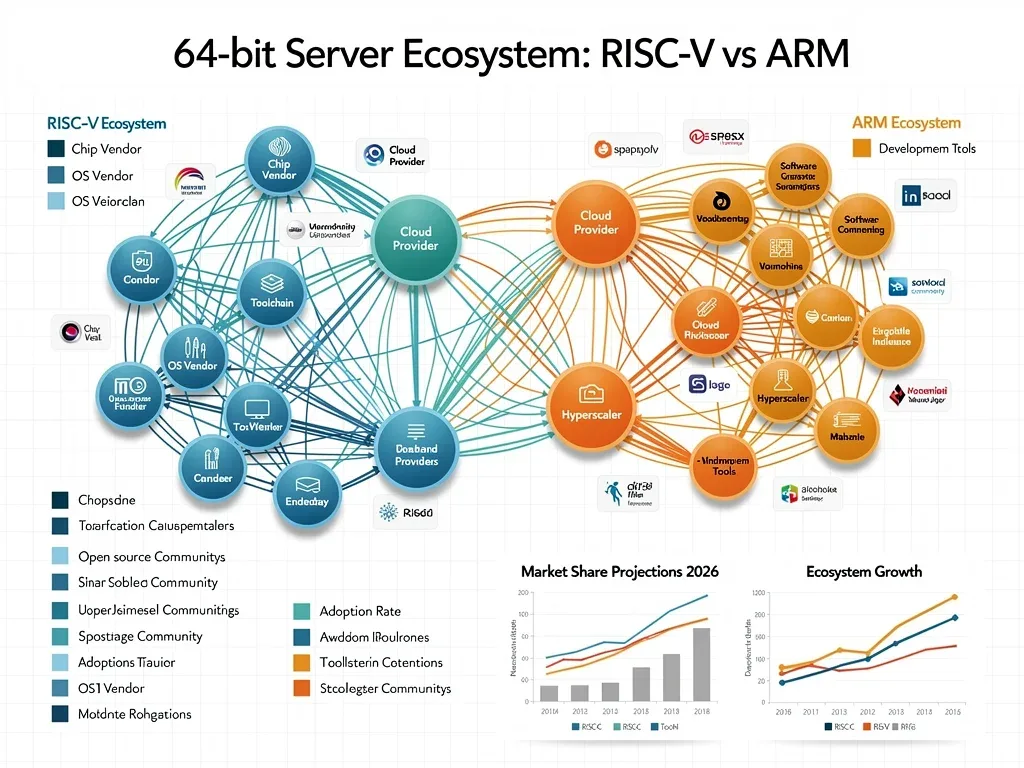
RISC-V, while newer, has seen an explosion of activity in its ecosystem. Major players are investing heavily in toolchain development, and community contributions are rapidly expanding the available software. While it may not match ARM's breadth by 2026, its open nature encourages rapid innovation and the creation of highly specialized tools for specific use cases. The growth of RISC-V International and various working groups is accelerating this maturation.
RISC-V's Accelerating Ecosystem Growth
RISC-V's ecosystem is rapidly evolving due to:
- Growing support from silicon vendors and FPGA providers.
- Increasing availability of open-source compilers, debuggers, and emulators.
- Active community contributions to operating system ports and libraries.
By 2026, ARM will retain its lead in overall ecosystem maturity, particularly for general-purpose applications where existing software compatibility is crucial. However, RISC-V's ecosystem will be robust enough to support a wider range of specialized embedded and server applications, with significant advancements in compiler optimizations and domain-specific toolchains. The benchmark for ecosystem maturity will shift from sheer breadth to the depth and quality of support for specific vertical markets.
Future Outlook and Strategic Considerations for 2026
Looking ahead to 2026, the architectural landscape for embedded systems and 64-bit server workloads will be characterized by increasing specialization and strategic diversification. The choice between RISC-V and ARM will less often be a simple 'better or worse' decision, and more about which architecture best aligns with specific project requirements, business models, and long-term strategic goals. Both architectures are evolving rapidly, driven by market demands and technological innovation.
ARM will continue to refine its proven designs, focusing on incremental performance gains, enhanced power efficiency, and integrated security features. Its strong market position and established IP licensing model will ensure its continued dominance in many traditional segments. Expect ARM to push further into high-performance computing and automotive, leveraging its deep industry partnerships.
ARM's Strategic Trajectory
- Continued optimization for performance-per-watt in cloud and edge computing.
- Deepening integration of AI/ML acceleration into its core designs.
- Expanding its software and services offerings to enhance developer experience.
RISC-V, as an open standard, will continue to gain momentum through its flexibility and the growing number of companies investing in its development. Its strength lies in enabling innovation and customization, allowing businesses to create highly differentiated products and avoid vendor lock-in. This makes RISC-V particularly appealing for startups and companies looking to build unique, vertically integrated solutions.
RISC-V's Growth Vectors
- Rapid expansion in specialized embedded markets and custom silicon.
- Increasing adoption in data center accelerators and niche server applications.
- A growing open-source community driving innovation and ecosystem development.
By 2026, the market will likely see a clear bifurcation. ARM will remain the industry standard for general-purpose, high-volume applications where a mature ecosystem and predictable performance are paramount. RISC-V will thrive in specialized, custom, and cost-sensitive applications, particularly where deep architectural control or freedom from licensing fees offers a significant competitive advantage. The architectural benchmarks will increasingly reflect these specialized use cases, moving beyond generic comparisons to workload-specific performance and efficiency metrics. Strategic decisions will involve a careful evaluation of not just technical specifications, but also long-term ecosystem support, customization potential, and supply chain resilience.
| Key Aspect | RISC-V in 2026 | ARM in 2026 |
|---|---|---|
| Licensing Model | Open-standard, royalty-free, highly customizable. | Proprietary, licensed IP cores, established ecosystem. |
| Embedded Systems | Strong in custom, specialized, and cost-sensitive applications. | Dominant in general-purpose, power-efficient, mature ecosystem. |
| Server Workloads | Emerging in specialized accelerators and custom data centers. | Strong contender against x86 in cloud and edge servers. |
| Ecosystem Maturity | Rapidly growing, strong community, accelerating toolchain development. | Mature, extensive software, broad toolchain, widespread support. |
Frequently Asked Questions About RISC-V and ARM in 2026
What are the primary advantages of RISC-V over ARM in 2026?▼RISC-V's main advantages include its open-source nature, offering unparalleled flexibility for customization, no licensing fees, and full transparency. This enables highly specialized designs, reduces costs for high-volume products, and allows for custom security implementations, making it ideal for niche embedded and accelerator applications.
Where will ARM likely maintain its dominance in 2026?▼ARM is expected to maintain dominance in general-purpose embedded systems, mobile devices, and a significant portion of the cloud and edge server markets. Its mature ecosystem, proven performance-per-watt, extensive software support, and established security frameworks provide a reliable and efficient solution for a wide range of applications.
How will power efficiency benchmarks compare between RISC-V and ARM?▼ARM will likely lead in general-purpose power efficiency due to its highly optimized, proprietary designs. However, RISC-V has the potential for superior power efficiency in custom implementations where designers can strip away unnecessary components and add specialized accelerators, achieving extreme optimization for specific embedded tasks.
What impact will security features have on architectural choices by 2026?▼Security is critical. ARM offers mature, hardware-backed solutions like TrustZone. RISC-V's open nature allows for transparent security audits and custom security extensions, appealing to sectors demanding ultimate control over their security posture, such as defense or critical infrastructure, enabling verifiable trust architectures.
Will RISC-V replace ARM in the server market by 2026?▼While RISC-V will not replace ARM's general-purpose server presence by 2026, it will gain significant traction in specialized server accelerators and custom data center solutions. ARM's Neoverse platform will likely solidify its position against x86, focusing on cloud-native workloads, while RISC-V targets niche, highly optimized applications.
Conclusion
The architectural landscape in 2026 for embedded systems and 64-bit server workloads reveals a dynamic and increasingly specialized competitive environment between RISC-V and ARM. While ARM will continue to leverage its mature ecosystem, proven performance, and comprehensive toolchains to dominate general-purpose applications, RISC-V is poised to disrupt markets demanding ultimate customization, cost efficiency, and verifiable security. The future is not about one architecture entirely displacing the other, but rather a strategic co-existence where each excels in its uniquely optimized domains, driving innovation across the entire computing spectrum. Decision-makers will need to carefully weigh the benefits of a proprietary, established platform against the flexibility and long-term cost advantages of an open-source alternative, aligning their choices with specific application requirements and strategic business objectives.
