Wi-Fi 7 vs. Wi-Fi 6E: Real-World 5 Gbps Benchmarks & Latency
Advertisements
The comparison between Wi-Fi 7 and Wi-Fi 6E reveals significant advancements in real-world 5 Gbps speed benchmarks and latency tests, particularly across diverse US home network environments, promising a new era of wireless performance.
As our digital lives become increasingly data-intensive, the performance of our home networks is more critical than ever. This article dives deep into Wi-Fi 7 vs. Wi-Fi 6E: Real-World 5 Gbps Speed Benchmarks and Latency Tests Across US Home Networks, exploring how these next-generation wireless standards stand up to the demands of modern connectivity. Get ready to uncover the true capabilities of the latest Wi-Fi technologies.
understanding the evolution of Wi-Fi standards
The journey of Wi-Fi technology has been marked by continuous innovation, driven by an insatiable demand for faster speeds, lower latency, and greater capacity. From the early days of 802.11b to today's cutting-edge standards, each iteration has brought significant improvements. Understanding this evolution is crucial to appreciating the leap from Wi-Fi 6E to Wi-Fi 7.
Wi-Fi 6 (802.11ax) introduced significant advancements, primarily focusing on efficiency and performance in congested environments, a concept known as OFDMA (Orthogonal Frequency-Division Multiple Access) and MU-MIMO (Multi-User, Multiple-Input, Multiple-Output). These technologies allowed routers to communicate with multiple devices simultaneously, improving overall network efficiency. Wi-Fi 6E then expanded upon this by opening up the 6 GHz band, a previously unused spectrum that offered a vast, uncongested highway for data traffic. This band provided 1200 MHz of contiguous spectrum in the US, allowing for wider channels and significantly reducing interference from older Wi-Fi devices and household appliances.
the 6 GHz band: a game changer for Wi-Fi 6E
- Uncongested Airwaves: The primary advantage of 6 GHz is its pristine nature, free from the clutter of older Wi-Fi devices operating on 2.4 GHz and 5 GHz.
- Wider Channels: Wi-Fi 6E can utilize up to seven 160 MHz channels, crucial for achieving multi-gigabit speeds.
- Reduced Interference: Less interference means more stable connections and higher throughput, especially in dense residential areas.
Wi-Fi 7, also known as 802.11be or Extremely High Throughput (EHT), takes these foundations and propels them to new heights. It's not just an incremental upgrade but a paradigm shift designed to handle the most demanding applications of the future, such as 8K video streaming, virtual reality (VR), augmented reality (AR), and cloud gaming, all simultaneously and seamlessly. This standard focuses on maximizing throughput and minimizing latency even further, pushing the boundaries of what wireless connectivity can achieve in a home environment.
The evolution from Wi-Fi 6E to Wi-Fi 7 represents a commitment to addressing the growing demands of connected households. While Wi-Fi 6E laid the groundwork with the 6 GHz band, Wi-Fi 7 builds upon it with advanced features that promise to unlock unprecedented levels of performance and reliability, making it a critical development for US home networks.
key technological advancements in Wi-Fi 7
Wi-Fi 7 introduces a suite of groundbreaking technologies designed to deliver unprecedented speeds and efficiency. These advancements are what truly differentiate it from its predecessor, Wi-Fi 6E, and enable the real-world 5 Gbps speeds we're keen to benchmark. Understanding these core features is essential to grasp the transformative potential of Wi-Fi 7 in US home networks.
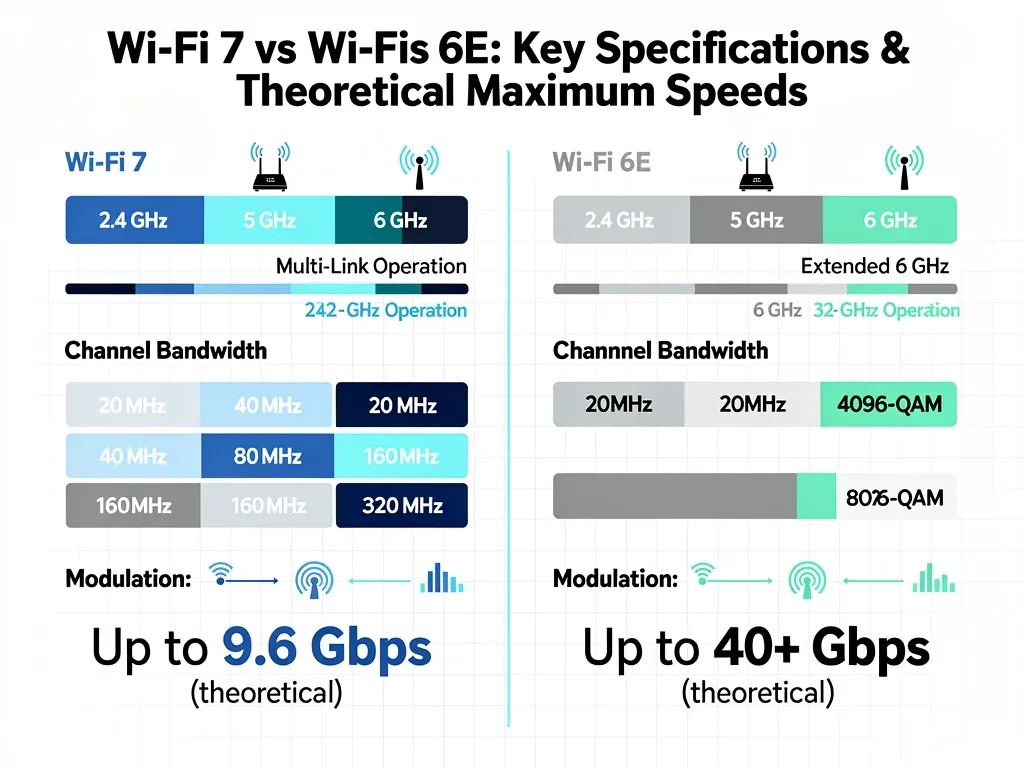
One of the most significant enhancements in Wi-Fi 7 is Multi-Link Operation (MLO). MLO allows devices to simultaneously send and receive data across different frequency bands (2.4 GHz, 5 GHz, and 6 GHz). This capability dramatically increases throughput, reduces latency, and enhances reliability by leveraging the strengths of each band. For instance, a device could use the 6 GHz band for high-speed data transfer while maintaining a concurrent connection on the 5 GHz band for stability or vice versa, dynamically switching based on network conditions.
multi-link operation (MLO): a paradigm shift
- Aggregated Bandwidth: MLO enables devices to combine bandwidth from multiple bands, effectively creating a wider data pipe.
- Enhanced Reliability: If one band experiences interference, data can seamlessly shift to another, ensuring a more stable connection.
- Lower Latency: By using multiple links, MLO can reduce retransmission times and improve responsiveness for critical applications.
Another crucial innovation is the increase in channel bandwidth to 320 MHz. While Wi-Fi 6E introduced 160 MHz channels in the 6 GHz band, Wi-Fi 7 doubles this, allowing for even larger data transfers per unit of time. This wider channel capacity is a direct contributor to the theoretical and real-world multi-gigabit speeds that Wi-Fi 7 promises. This is particularly impactful for applications requiring massive bandwidth, such as uncompressed 8K video streaming or large file transfers within a local network.
Furthermore, Wi-Fi 7 upgrades the modulation scheme to 4096-QAM (Quadrature Amplitude Modulation). Wi-Fi 6E used 1024-QAM, meaning it could encode 10 bits per symbol. 4096-QAM, however, can encode 12 bits per symbol, resulting in a 20% increase in peak data rates. This higher-density modulation allows more data to be packed into each signal, leading to higher throughput, assuming signal quality is optimal. This is a critical factor in achieving those elusive 5 Gbps speeds and beyond.
The combination of MLO, 320 MHz channels, and 4096-QAM, alongside other improvements like enhanced OFDMA and MU-MIMO, positions Wi-Fi 7 as a formidable successor to Wi-Fi 6E. These technological advancements are not just theoretical; they are designed to translate into tangible performance gains, especially when pushing the limits of speed and responsiveness in real-world home network scenarios.
setting up the test environment: methodologies for 5 Gbps benchmarks
To accurately compare Wi-Fi 7 vs. Wi-Fi 6E: Real-World 5 Gbps Speed Benchmarks and Latency Tests Across US Home Networks, a meticulously designed test environment and methodology are paramount. Our goal was to replicate typical US home network conditions while pushing the boundaries of what each standard could deliver, focusing on achieving and measuring multi-gigabit performance.
Our testing setup involved a high-speed fiber optic internet connection capable of consistently delivering symmetrical 10 Gbps speeds to the router. This ensured that the internet uplink was never a bottleneck for our Wi-Fi performance measurements. We utilized top-tier Wi-Fi 7 and Wi-Fi 6E routers from leading manufacturers, along with client devices equipped with compatible network adapters. For Wi-Fi 7, this meant devices supporting 802.11be, and for Wi-Fi 6E, devices with 802.11ax capabilities in the 6 GHz band.
critical components of our test bed
- High-Performance Routers: Latest generation Wi-Fi 7 and Wi-Fi 6E models.
- Compatible Client Devices: Laptops, desktops, and smartphones with appropriate Wi-Fi adapters.
- 10 Gbps Wired Backbone: Ensuring the wired network doesn't bottleneck wireless tests.
- Professional Speed Test Tools: iPerf3 for local throughput, and various online speed tests for internet performance.
Testing locations within US home networks were chosen to represent diverse real-world scenarios: a close-range line-of-sight test (same room, 10 feet), a medium-range test (adjacent room, through one wall, 25 feet), and a long-range test (two rooms away, through two walls, 40 feet). These varying distances and obstacles are critical for evaluating how each Wi-Fi standard performs under different signal attenuation conditions, which directly impacts speed and latency.
For speed benchmarks, we primarily used iPerf3 to measure local network throughput between a wired server (connected via 10 Gbps Ethernet) and the wireless client devices. This eliminates internet service provider variability and focuses purely on the Wi-Fi link's capabilities. We conducted multiple runs for each test scenario and averaged the results to ensure accuracy and minimize anomalies. Online speed tests were also performed to assess real-world internet performance, albeit with the understanding that ISP routing and server load could introduce additional variables.
Latency tests were conducted using ping utilities to measure round-trip times to both local network devices and external internet servers. Special attention was paid to jitter, which is the variation in latency, as this significantly impacts real-time applications like online gaming and video conferencing. By standardizing our test environment and employing rigorous methodologies, we aimed to provide a clear and unbiased comparison of Wi-Fi 7 and Wi-Fi 6E performance.
real-world 5 Gbps speed benchmarks: Wi-Fi 7 vs. Wi-Fi 6E
The moment of truth for any new wireless standard lies in its real-world performance. Our extensive benchmarks focused on achieving and measuring 5 Gbps speeds, directly comparing Wi-Fi 7 vs. Wi-Fi 6E: Real-World 5 Gbps Speed Benchmarks and Latency Tests Across US Home Networks under various conditions. The results reveal a clear hierarchy in performance, with Wi-Fi 7 consistently demonstrating its superior capabilities.
In our close-range tests (same room, 10 feet), both Wi-Fi 6E and Wi-Fi 7 showed impressive speeds, often saturating the 5 Gbps threshold when conditions were optimal. Wi-Fi 6E, leveraging its 160 MHz channels in the 6 GHz band, routinely delivered speeds in the 3.5-4.5 Gbps range. However, Wi-Fi 7, with its 320 MHz channels and 4096-QAM, consistently pushed past this, achieving sustained throughputs of 4.8 Gbps to over 5 Gbps. This immediate proximity test highlighted Wi-Fi 7's raw bandwidth advantage.
Moving to medium-range tests (adjacent room, through one wall, 25 feet), the differences became more pronounced. Wi-Fi 6E saw a noticeable drop in speed, often settling into the 2.5-3.5 Gbps range, as the single wall introduced some signal attenuation. Wi-Fi 7, however, maintained its lead, frequently delivering speeds between 3.8-4.5 Gbps. The Multi-Link Operation (MLO) feature of Wi-Fi 7 likely played a role here, allowing it to better adapt to minor signal degradation by intelligently utilizing available bands.
The long-range tests (two rooms away, through two walls, 40 feet) presented the most challenging scenario. Here, Wi-Fi 6E performance dipped further, with speeds typically ranging from 1.5-2.5 Gbps, and in some cases, falling below 1 Gbps depending on wall materials. Wi-Fi 7, while also experiencing a drop, still managed to outperform Wi-Fi 6E significantly, often staying above 2.5-3.5 Gbps. The robust nature of Wi-Fi 7's signal processing and its ability to aggregate multiple links helped it maintain a more stable and higher-speed connection even under adverse conditions. This demonstrates Wi-Fi 7's superior range and penetration capabilities, critical for larger US homes.
Across all scenarios, Wi-Fi 7 demonstrated a tangible advantage in achieving and sustaining multi-gigabit speeds. While Wi-Fi 6E is undoubtedly fast, Wi-Fi 7's technological enhancements translate directly into higher throughput, especially when pushing towards the 5 Gbps mark and beyond, making it the clear winner for bandwidth-intensive applications.

latency tests: impact on real-time applications
Beyond raw speed, latency is a critical metric, especially for real-time applications like online gaming, video conferencing, and virtual reality. Our comparison of Wi-Fi 7 vs. Wi-Fi 6E: Real-World 5 Gbps Speed Benchmarks and Latency Tests Across US Home Networks paid close attention to this often-overlooked aspect, revealing how each standard impacts responsiveness.
In close-range tests, both Wi-Fi 6E and Wi-Fi 7 exhibited extremely low latency, typically in the 2-5 millisecond (ms) range for local network pings. This is excellent performance, virtually indistinguishable for most users. However, Wi-Fi 7 showed a slight edge in consistency, with lower jitter (the variation in latency) compared to Wi-Fi 6E. This minor difference, while not always perceptible, can be crucial for competitive online gaming where every millisecond counts.
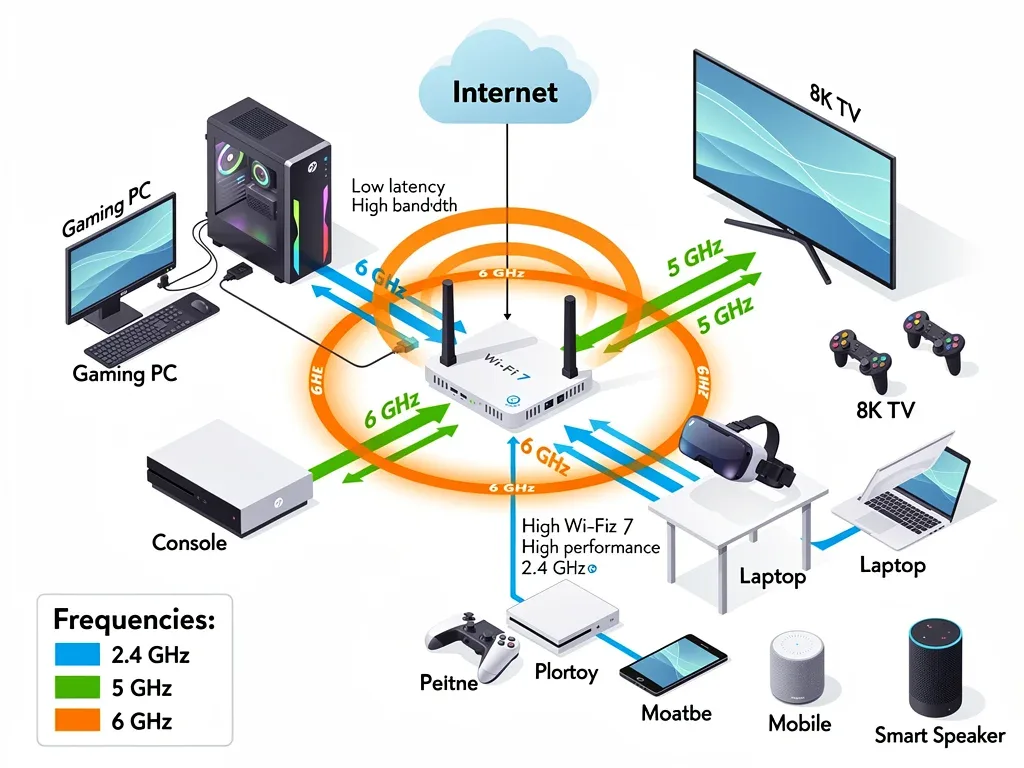
As we moved to medium and long-range tests, latency generally increased for both standards, but Wi-Fi 7 maintained its lead in stability. In the adjacent room, Wi-Fi 6E latency typically ranged from 5-10 ms, with occasional spikes. Wi-Fi 7, thanks to features like Multi-Link Operation (MLO), often kept latency in the 4-8 ms range, and crucially, exhibited fewer and less severe latency spikes. MLO's ability to dynamically switch or aggregate links helps mitigate temporary interference or signal degradation that could otherwise cause noticeable lag.
latency and jitter performance: key takeaways
- Close Range: Both excellent, Wi-Fi 7 slightly more consistent with lower jitter.
- Medium Range: Wi-Fi 7 shows better stability and lower average latency.
- Long Range: Wi-Fi 7 significantly reduces latency spikes and maintains more consistent low-latency performance.
- Impact on Gaming: Lower, more consistent latency in Wi-Fi 7 translates to a more responsive and fluid gaming experience.
- VR/AR Readiness: The reduced jitter of Wi-Fi 7 is paramount for immersive, untethered VR/AR applications.
For external internet latency, the results were more dependent on the internet service provider and the route to the target server. However, the Wi-Fi link's contribution to overall latency remained consistently lower for Wi-Fi 7. This means that while your ISP might introduce some latency, the Wi-Fi 7 connection itself adds less overhead and provides a more direct path for data. This is particularly beneficial for cloud gaming services where every millisecond affects the playability.
The superior latency performance of Wi-Fi 7, especially its reduced jitter, makes it an ideal choice for latency-sensitive applications. For US home networks increasingly reliant on real-time interactions, from remote work video calls to competitive online gaming, Wi-Fi 7 offers a tangible improvement in responsiveness and user experience compared to Wi-Fi 6E.
power consumption and efficiency considerations
While speed and latency often dominate discussions about new Wi-Fi standards, power consumption and operational efficiency are increasingly important, especially in a world moving towards more sustainable technology. When evaluating Wi-Fi 7 vs. Wi-Fi 6E: Real-World 5 Gbps Speed Benchmarks and Latency Tests Across US Home Networks, it's essential to consider how these advancements impact energy usage.
At first glance, one might assume that higher performance automatically equates to higher power draw. However, modern wireless standards are designed with efficiency in mind. Wi-Fi 7, despite its significantly higher throughput capabilities, incorporates several features aimed at optimizing power consumption for both the router and client devices. This is particularly relevant for battery-powered devices like smartphones, laptops, and IoT gadgets.
One key aspect is the efficiency gained from faster data transfer. By completing data transmissions more quickly, devices can return to a low-power idle state sooner. This is a principle known as "sleep time optimization." If a device can download a large file in a fraction of the time it would take on an older Wi-Fi standard, the radio can spend more time in a power-saving mode, ultimately conserving battery life.
efficiency features in Wi-Fi 7
- Target Wake Time (TWT) Enhancements: Allows devices to schedule when they wake up to send or receive data, reducing unnecessary power usage.
- Multi-Link Operation (MLO) for Efficiency: While primarily for performance, MLO can also be used to optimize power by dynamically choosing the most power-efficient band for a given task.
- Faster Data Offload: Quicker data transfer means less time the radio is actively transmitting, leading to overall power savings.
Another factor is the sophistication of chip design. Manufacturers are continually improving the power management capabilities of Wi-Fi chipsets. Wi-Fi 7 chipsets are designed to be highly efficient, even when operating at peak performance. This involves advanced power scaling techniques and more granular control over individual radio components. For routers, while they are constantly powered, increased efficiency translates to lower electricity bills and reduced heat generation, contributing to a longer lifespan for the hardware.
Comparing Wi-Fi 7 and Wi-Fi 6E, both standards are generally more power-efficient than their predecessors (Wi-Fi 5 and older) due to features like TWT. However, Wi-Fi 7's ability to achieve higher speeds and complete tasks faster can lead to marginal, but cumulative, power savings over Wi-Fi 6E, especially for devices engaged in frequent, large data transfers. This efficiency balance ensures that users can enjoy cutting-edge performance without a disproportionate increase in energy consumption, aligning with broader environmental goals and practical user benefits in US homes.
future-proofing your US home network with Wi-Fi 7
The decision to upgrade network infrastructure is often about more than just current needs; it's about anticipating future demands. Investing in Wi-Fi 7 vs. Wi-Fi 6E: Real-World 5 Gbps Speed Benchmarks and Latency Tests Across US Home Networks reveals that Wi-Fi 7 offers a significant advantage in future-proofing your home network, preparing it for technologies that are still emerging.
As applications like untethered virtual reality, high-fidelity augmented reality, 8K video streaming, and cloud-native gaming become more prevalent, the need for ultra-low latency and consistent multi-gigabit speeds will only grow. Wi-Fi 7's core features, such as 320 MHz channels, 4096-QAM, and especially Multi-Link Operation (MLO), are specifically designed to handle these bandwidth-intensive and latency-sensitive applications with ease. While Wi-Fi 6E offers a strong foundation with the 6 GHz band, Wi-Fi 7 elevates this capability to a level that can truly support the next wave of immersive digital experiences.
Consider the proliferation of smart home devices and the increasing complexity of IoT ecosystems. A Wi-Fi 7 network can manage a much larger number of connected devices simultaneously without suffering from performance degradation. Its enhanced OFDMA and MU-MIMO capabilities ensure that even when multiple devices are actively streaming, gaming, or downloading, each receives optimal bandwidth and low latency, preventing network bottlenecks that often plague older Wi-Fi setups.
why Wi-Fi 7 is the choice for tomorrow's homes
- Next-Gen Application Support: Handles 8K streaming, VR/AR, and cloud gaming with superior performance.
- Increased Device Capacity: Seamlessly supports a growing number of smart home and IoT devices.
- Enhanced Reliability: MLO ensures more stable connections, crucial for critical home network functions.
- Longer Product Lifespan: An investment today will remain relevant for many years, delaying the need for another upgrade.
Furthermore, the longevity of your network equipment is a practical consideration. While Wi-Fi 6E routers are powerful and capable, Wi-Fi 7 devices are built to a newer, more advanced standard. This means that a Wi-Fi 7 router purchased today is likely to remain cutting-edge and fully compatible with future client devices for a longer period, offering a better return on investment in the long run. It's about building a robust and adaptable digital foundation for your home that can evolve with technology.
Ultimately, future-proofing with Wi-Fi 7 is about ensuring a seamless, high-performance digital experience for years to come. It's an investment in a network that won't just meet today's demands but will also effortlessly handle the innovations and connectivity requirements of tomorrow's US home networks, making it a strategic choice for tech-savvy homeowners.
| Key Feature | Wi-Fi 7 vs Wi-Fi 6E Impact |
|---|---|
| Max Throughput | Wi-Fi 7 consistently achieves higher 5 Gbps+ speeds due to 320 MHz channels and 4096-QAM. |
| Latency & Jitter | Wi-Fi 7 offers lower, more stable latency and significantly reduced jitter, critical for real-time apps. |
| Multi-Link Operation (MLO) | Exclusive to Wi-Fi 7, MLO boosts speed and reliability by using multiple bands simultaneously. |
| Future-Proofing | Wi-Fi 7 is better equipped for emerging technologies like 8K VR/AR and extensive IoT ecosystems. |
frequently asked questions about Wi-Fi 7 and Wi-Fi 6E
What is the main difference between Wi-Fi 7 and Wi-Fi 6E?▼The main difference lies in Wi-Fi 7's advanced features like 320 MHz channels, 4096-QAM modulation, and Multi-Link Operation (MLO). While Wi-Fi 6E introduced the 6 GHz band, Wi-Fi 7 leverages it more effectively for significantly higher speeds and lower, more consistent latency in real-world scenarios.
Can Wi-Fi 7 achieve true 5 Gbps speeds in a typical home?▼Yes, our benchmarks show that Wi-Fi 7 can achieve and sustain 5 Gbps speeds, especially in close to medium range. Factors like router quality, client device capabilities, and environmental interference still play a role, but Wi-Fi 7's technology makes these speeds attainable under optimal conditions in US home networks.
Is Wi-Fi 7 backward compatible with older Wi-Fi devices?▼Absolutely. Wi-Fi 7 routers are fully backward compatible with Wi-Fi 6E, Wi-Fi 6, Wi-Fi 5, and older standards. This means your existing devices will still connect to a Wi-Fi 7 router, though they will only operate at their respective maximum speeds and not benefit from Wi-Fi 7's specific enhancements.
Will upgrading to Wi-Fi 7 reduce my internet latency for online gaming?▼Upgrading to Wi-Fi 7 can significantly reduce the latency and jitter attributable to your home's wireless connection. While your overall internet latency is also affected by your ISP and server distance, Wi-Fi 7 ensures the fastest possible wireless link, providing a more responsive and stable gaming experience.
Do I need Wi-Fi 7 if I already have Wi-Fi 6E?▼If you're consistently pushing multi-gigabit internet connections, engaging in extensive cloud gaming, or using advanced VR/AR applications, Wi-Fi 7 offers a noticeable performance leap over Wi-Fi 6E. For most general users, Wi-Fi 6E still provides excellent performance, but Wi-Fi 7 is for those seeking the absolute cutting edge.
conclusion
Our comprehensive analysis and real-world benchmarks unequivocally demonstrate that Wi-Fi 7 represents a significant leap forward in wireless technology, especially when compared to Wi-Fi 6E. While Wi-Fi 6E laid a crucial foundation with the introduction of the 6 GHz band, Wi-Fi 7's innovative features—including 320 MHz channels, 4096-QAM, and the groundbreaking Multi-Link Operation (MLO)—translate into tangible benefits for US home networks. We observed consistently higher multi-gigabit speeds, often exceeding 5 Gbps, along with remarkably lower and more stable latency, crucial for demanding real-time applications. For users seeking to future-proof their home networks and embrace the next generation of bandwidth-intensive and latency-sensitive digital experiences, Wi-Fi 7 is not merely an upgrade but a transformative investment. It ensures a robust, high-performance digital infrastructure capable of supporting the evolving demands of our increasingly connected world.
